You Are Away for Two Months. The Car Is Not.
Twenty minutes before you leave for the airport decides whether the car starts when you come back.
The most predictable breakdown in the country
Ask any workshop in Dubai what September looks like and you will get the same answer: a queue of cars that will not start, belonging to people who have just landed.
It is entirely predictable and almost entirely preventable, and the reason it keeps happening is that "parking the car" does not feel like an action that requires preparation. You are not doing anything to it. Nothing should change.
Except that a car left standing in a UAE summer is under continuous load: an electrical drain that never stops, a battery losing capacity to heat, tyres deforming under static weight, and a cabin cycling to oven temperatures every afternoon for sixty days.
What follows takes about twenty minutes on the day you leave.
The battery is what actually strands you
A modern car never fully sleeps. The alarm, the immobiliser, the telematics module, the keyless-entry receiver and a dozen control units all draw current continuously. That is parasitic drain, and on a car left for two months it is more than enough to flatten a healthy battery.
Heat makes it worse in two ways at once. A battery self-discharges faster when hot, and heat is separately destroying its capacity — the data is stark, with a battery rated for ten years at 25 °C managing roughly 30 months at 41 °C.
So the car that would have survived eight weeks parked in Munich does not survive eight weeks parked in Al Quoz.
And the damage is not just an inconvenient no-start. A lead-acid battery left deeply discharged sulphates, and sulphation is not recovered by charging. The battery that gets jump-started in September is often a battery that has permanently lost a large part of its capacity — which is why it fails again in November and everyone blames the jump-start.
Two fixes, in order of preference:
A battery maintainer on a socket, if the car is somewhere with power. Unlike a plain charger it monitors and tops up, so it neither overcharges nor lets the battery sit low.
Disconnect the negative terminal if there is no power. Cheaper, free, and effective against the drain — at the cost of losing radio presets and possibly needing to re-sync a window or two. Note that on some cars this affects the alarm, so check before you rely on it.
Source: Battery University, BU-806a
Tyres: pressure now, or flat spots later
Tyres lose pressure slowly all the time, and a tyre that starts at the correct pressure in July is meaningfully under-inflated by September.
That matters because the whole weight of the car is resting on four contact patches the size of a hand. On an under-inflated tyre, standing in heat, the rubber takes a set — a flat spot — which you feel as vibration for the first few kilometres and, if the car sat long enough, permanently.
The preparation is trivial: inflate above your normal pressure before you leave, so that after two months of gradual loss the tyre is still adequately inflated rather than soft. Then set them back to the door-placard figure when you return, cold, before driving properly.
If the car is going to sit for many months rather than a summer, taking the weight off entirely with jack stands is the thorough answer. For an eight-week holiday it is overkill.
And while you are down there, read the DOT codes. A car that spends its summers parked is exactly the profile that gets caught by the five-year tyre age limit at inspection.
Where you park matters more than anything else you do
If you have a choice between a shaded basement space and an open lot, take the basement even if it costs money. Everything else on this list is mitigating heat; parking in shade removes it.
A cabin left in the sun gains around 22 °C in an hour, roughly 80% of it in the first thirty minutes. Repeat that daily for sixty days and it is why returning owners find cracked dashboard trim, hardened rubber seals, a delaminating screen protector on the infotainment display, and an interior that smells of hot plastic.
Under cover, none of that happens.
If outdoors is the only option: a windscreen shade, and a breathable cover if you have one. Avoid a cheap plastic tarpaulin — it traps moisture against the paint and moves in the wind, which does more harm to the clearcoat than the sun would have.
The five smaller things
Fill the tank. A full tank leaves less air space for humid air to condense in, and coastal humidity here is genuinely high even when the inland air is dry.
Wash it first, including underneath. Bird droppings and dead insects are acidic and etch clearcoat, and two months of daily 45 °C bakes them in. Ten minutes at a wash before you leave saves a paint correction later.
Do not leave the handbrake on for two months. On a car with rear discs the pads can bond to the disc. Leave it in park, and chock a wheel if the ground slopes.
Take everything perishable out. Anything that can melt, ferment or explode will do so. A plastic water bottle in a 70 °C cabin is a genuinely bad idea, and so is a lighter or an aerosol.
Check your registration and insurance dates. This is the one that costs real money — people discover on landing that registration expired in week three and the car has been uninsured on a public parking space ever since. If the renewal falls while you are away, deal with it before you go.
And ask somebody to start it once
If you have a friend, a neighbour or a driver who can visit once in the middle, that single visit does more than everything else combined.
What you want from it is not a two-minute idle in the parking space. That is worse than nothing: it wakes the engine, pulls charge out of the battery to crank it, and never runs long enough to put that charge back or to reach proper operating temperature.
What helps is a fifteen to twenty minute drive — long enough to charge the battery properly, circulate oil, move the tyres off their flat spots and run the air-conditioning compressor, which needs to circulate refrigerant to keep its own lubrication and seals alive.
One proper drive at the halfway point turns a two-month layup into two four-week ones, and four weeks is a duration most cars handle without complaint.
Cars in the fleet where the summer is our problem
On a DYD lease the vehicle stays registered to us, so the registration renewal, the inspection and the servicing calendar are ours to watch while you are away. Live prices — the monthly covers the vehicle, with comprehensive insurance, RTA registration and admin in one annual renewal fee.
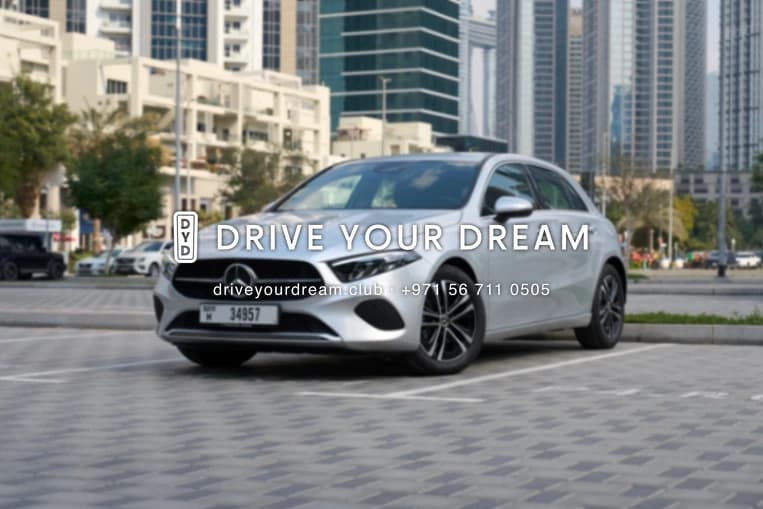
Mercedes-Benz A-Class 2023

Mercedes-Benz A-Class 2023

Mercedes-Benz A-Class 2023
When you get back
Do not simply get in and drive to the office.
Set tyre pressures cold, back down to the door placard figure, before the first proper drive.
Expect the first few kilometres to feel odd — flat spots work themselves out as the tyres warm, and a slight vibration that fades is normal. One that does not fade is not.
Let the air conditioning run before you judge it. Two months of standing does not improve an A/C system, and weak cold on the first drive is worth investigating rather than tolerating.
Look underneath where the car was parked. Two months is long enough for a slow leak to leave an obvious mark, and a stain on the concrete is the cheapest diagnostic you will ever get.
Book the battery a load test rather than waiting to be stranded. A voltmeter reading 12.6 V tells you the state of charge, not the state of health — and after a summer parked, state of health is exactly the question.
Frequently Asked Questions
How do I stop my car battery dying while I am away for the summer in the UAE?
Use a battery maintainer if the parking space has power — unlike a plain charger it monitors and tops up without overcharging. If there is no power, disconnect the negative terminal, which stops the parasitic drain from the alarm, telematics and control units. Check first whether disconnecting affects your alarm.
Is it bad to leave a car parked for two months in Dubai heat?
It is the most predictable breakdown in the country. Heat both accelerates battery self-discharge and destroys capacity — a battery rated for ten years at 25 °C manages roughly 30 months at 41 °C — while parasitic drain runs continuously. A deeply discharged lead-acid battery sulphates, and that capacity does not come back with charging.
Should I inflate my tyres before storing a car?
Yes. Inflate above your normal pressure before leaving, so that after weeks of gradual loss the tyres are still adequately inflated rather than soft. A car standing on under-inflated tyres in heat develops flat spots, felt as vibration on the first drive and sometimes permanent. Reset to the door-placard pressure cold when you return.
Should someone start my car while I am away?
Only if they actually drive it. A two-minute idle is worse than nothing — it pulls charge out to crank the engine and never runs long enough to replace it or reach operating temperature. A fifteen to twenty minute drive at the halfway point charges the battery, circulates oil, moves the tyres off their flat spots and runs the A/C compressor.
What is the most expensive mistake people make leaving a car in the UAE?
Letting registration or insurance lapse while abroad. People land to discover the registration expired in week three and the vehicle has been sitting uninsured in a public space since. If a renewal falls during your trip, handle it before you go. On a leased vehicle the registration stays with the leasing company, which removes that failure mode entirely.
Run your own number
The calculator shows both lines — the monthly payment for the vehicle and the annual renewal fee covering insurance, registration and admin.
On a lease this is our problem