The Rules We Put on the Website Instead of in Clause 14
Every restriction here traces back to one of two facts. Once you know which, the whole list stops looking arbitrary.
Why this is a page and not a clause
Restrictions in this industry live in the back half of the contract, in the paragraph nobody reads, and they surface at the worst possible moment — usually at a border, or after a recovery, or when a claim is declined.
We would rather publish them, because every argument we have ever had about them came from somebody finding out late. A customer who knows the rules before signing either accepts them or leases from someone else, and both of those outcomes are better than the third one.
So here is the complete list, and — more usefully — why each one exists.
Almost none of them are our preference. They come from two facts that sit underneath the whole arrangement:
One: the vehicle stays registered to Drive Your Dream for the entire term. You drive it, you pay it off, it becomes yours at the end — but until then, on paper, it is our asset. That is what makes lease-to-own work without a bank, and it is the source of half the list.
Two: the comprehensive insurance policy is ours, and it is a normal UAE motor policy. It is not a special product with exotic cover. It excludes what those policies exclude, and no wording in our contract can make an insurer pay for something its policy does not cover. That is the other half.
Off-road and desert driving: not permitted
This is the one people ask about most, usually hopefully.
The answer is no, and the reason is not that we think you will crash. It is that standard comprehensive motor insurance in the UAE commonly excludes off-road use altogether. Off-road cover and off-road recovery are typically sold as add-ons, not included by default — which means that on a normal policy, a car buried to its axles at Sweihan is not an insurance event. It is an invoice.
On top of that, sand does specific damage that shows up later and is hard to attribute: it packs the cooling stack from the front, works into the underbody, and gets into places that only appear in a service bill eighteen months on. On a three-year lease that bill lands on us.
We have written a full guide to desert driving anyway, because it is the best thing about living here and the safety information should exist regardless of who profits from it. It just is not something to do in a car that is registered to us.
Track days and anything timed: not permitted
This one surprises people more than the desert, because a track feels like the *safe* place to drive quickly. Legally and commercially it is the opposite.
Circuit use is an explicit exclusion in virtually every comprehensive motor policy. The wording varies but the substance does not: racing, speed contests and timed events are out. And the industry rule of thumb is broader than most drivers expect — if you are being timed, you are racing, regardless of whether anyone is competing against you and regardless of how sedate your lap was.
So the moment a car goes out on a circuit at an organised session, comprehensive and collision cover stop. Not reduced. Stopped.
There is a specialist product — track day insurance — that fills part of that gap. Two things worth knowing about it: it covers non-competitive track days only, and it typically excludes mechanical and electrical failure, which is what actually goes wrong on track. A blown engine or a cooked gearbox on lap fourteen is not covered by the track policy either.
Which is why the answer here is a flat no rather than a "let us look into it". There is no configuration of this that ends with the risk sitting anywhere other than on us.
Source: Standard comprehensive motor policy exclusions; specialist track-day cover terms
Towing a trailer: yes, with the right licence
Here the answer is different, and it is worth being precise because the blanket assumption is usually that it is banned.
Towing is permitted, provided two things are true:
You hold the correct licence category and any permit the load requires. This is not a formality — towing a trailer, a boat, a quad or a jet ski above certain weights has its own licensing requirements in the UAE, and driving outside your category is both illegal and, separately, a reason for an insurer to decline.
You tell us first, because it may carry an additional insurance charge. Towing changes the risk profile of the vehicle, and insurers price it. That is a real cost rather than a bureaucratic hurdle, and it is far cheaper to arrange in advance than to discover after an incident that the policy did not contemplate a trailer.
So: bring the boat, tell us about it, and let us confirm what the policy needs. The answer is usually yes and a number.
Taking the car out of the UAE: not permitted
This is the restriction most people assume is negotiable, and it is the one where our answer is least about us.
A UAE-registered vehicle crossing into Oman or Saudi Arabia needs several things: valid registration, a licence, passport and Emirates ID, and insurance that is valid in the destination country — the Orange Card, which for Oman can be bought at the border as five-day third-party cover for roughly AED 106 if your own policy does not extend.
And if the vehicle is financed or mortgaged, it needs one more thing: a No Objection Certificate from the party that owns it.
Here is what that actually looks like in practice, and it is the part nobody mentions until you try. Ask a UAE bank for an NOC on a financed car and you may be told to deposit an amount equal to the entire outstanding loan balance, plus a processing fee of around 2%, with about three working days to issue it.
Read that again. The bank is not charging you for paperwork. It is asking you to fully collateralise the loan in cash before it will let its security leave the jurisdiction — because once the car is across a border, the bank's ability to recover it collapses.
So this is not a leasing quirk. It is how the entire financed-vehicle market in this country treats cross-border travel, for exactly the reason you would expect: an asset outside the jurisdiction is an asset outside the courts. Our position is the same as a bank's, arrived at from the same place, and we say no rather than constructing a deposit mechanism that would cost you more than the trip.
If you want to drive to Musandam or Salalah, do it in a car you own outright with an Orange Card, or in a rental from a company whose product is built for it. Both are straightforward. A financed car is the one option that is not.
Source: UAE bank NOC practice for mortgaged vehicles; Oman border documentation requirements
Mileage: 25,000 km a year, and what happens above it
The standard allowance is 25,000 km per year — about 2,083 km a month.
For context, a typical Dubai pattern is a 30 km each-way commute over roughly 250 working days, which is 15,000 km, plus about 5,000 km of weekends and errands. That is 20,000, so the standard allowance carries roughly 25% of headroom above ordinary use.
If you know you will exceed it, there are packages: 35,000 km/year for sales roles, agents and long commutes, and 50,000 km/year for genuinely heavy drivers. They are cheaper per kilometre than paying excess afterwards, and they can be added at signing or mid-term.
Without a package, excess mileage is AED 10 per kilometre over the allowance, applied at contract end or annual review.
Every vehicle carries GPS, so mileage is visible to both sides in real time rather than being a surprise at the end. The useful habit: divide your allowance by twelve and check the odometer monthly. If you are consistently over by mid-year, upgrading the package costs less than the excess will.
Cars in the fleet, on exactly these terms
Everything on this page applies to every car here. Live prices — the monthly covers the vehicle, with comprehensive insurance, RTA registration and admin in one annual renewal fee of 5% of vehicle value, minimum AED 8,000.
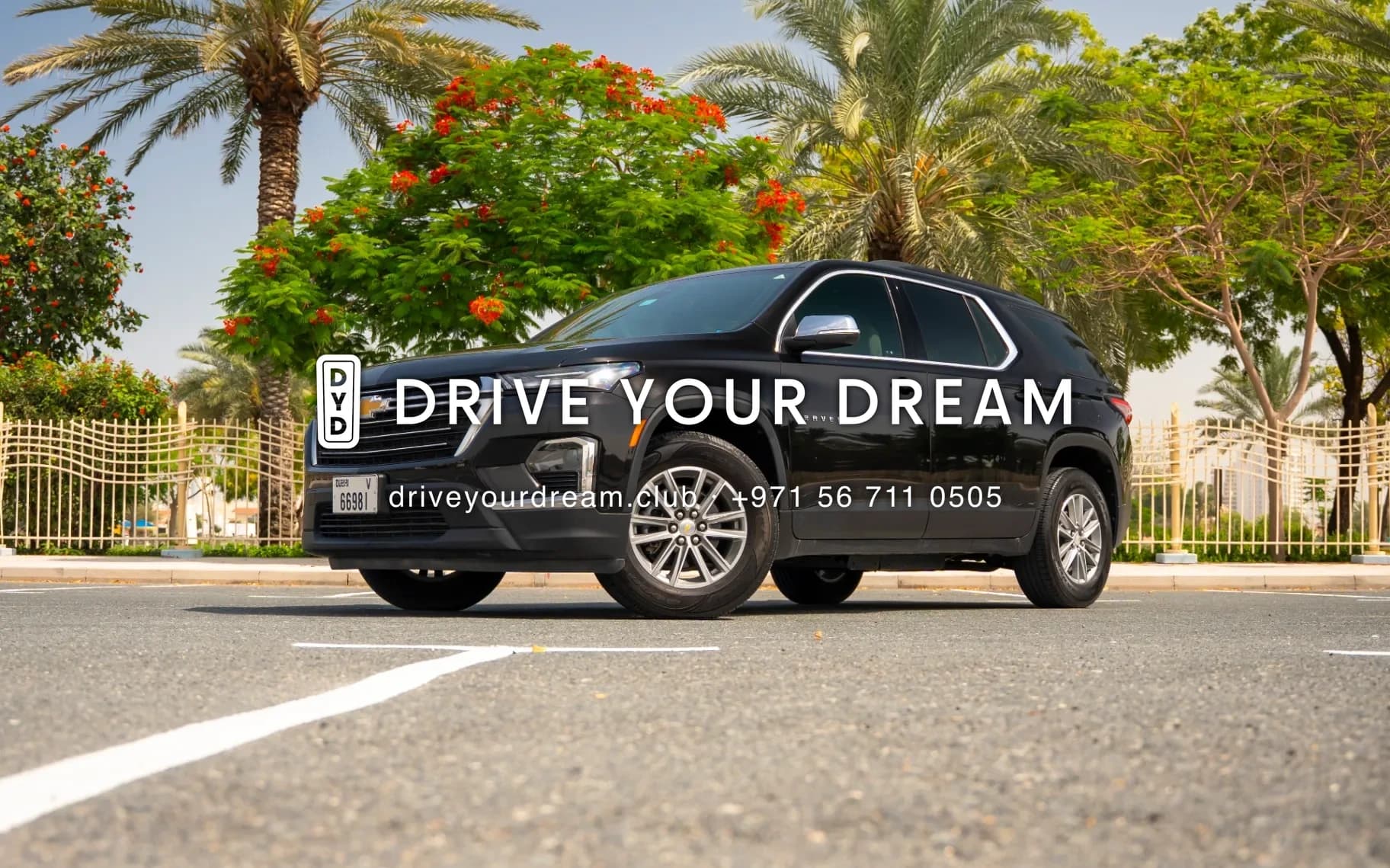
Chevrolet Traverse 2023
Mercedes-Benz A-Class 2023

Mercedes-Benz A-Class 2023

Mercedes-Benz A-Class 2023
The pattern, if you want the short version
Look back at the list and the logic is consistent.
Where the insurer will not cover it, we say no. Desert and track are both explicit exclusions in a normal comprehensive policy, so there is no version where the risk is carried by anyone but us.
Where the risk can be priced, we say yes and price it. Towing is a legitimate use of a car; it changes the exposure, the insurer quotes it, everyone knows where they stand.
Where the asset leaves our reach, we say no. Crossing a border removes the enforceability that makes the whole structure work — which is why banks demand full cash collateral for the same trip.
Where it is simply wear, we meter it. Mileage is not forbidden, it is measured, with packages for people who need more.
None of that requires you to trust our judgement. You can check every one of these against your own insurer or your own bank and get the same answer.
And what we would rather you did
A restriction is more useful when it comes with the alternative, so:
Want to drive dunes? Go with a club — the graded drives take beginners and you will learn more in one Friday than in a year of solo attempts. Use a car you own with off-road cover added, or a purpose-built desert rental.
Want track time? Yas Marina and Dubai Autodrome both run open sessions with cars provided and instruction included. It is a better first experience than your own car anyway, and nothing you own is at risk.
Want the Musandam road or Salalah? Rent for the week from a company whose product includes the crossing. It is a fraction of what a bank would ask you to deposit for an NOC.
Want to tow? Tell us what and how heavy, and we will come back with the licence requirement and the insurance number.
We would rather answer these questions in advance and lose the occasional deal than have the conversation after something has happened. That is genuinely the whole reason this page exists.
Frequently Asked Questions
Can I take a leased car off-road or into the desert in the UAE?
No — off-road and desert driving is excluded from Drive Your Dream lease agreements. The underlying reason is that standard comprehensive motor insurance in the UAE commonly excludes off-road use, with off-road cover and recovery sold as add-ons, so a stuck or damaged car in the dunes is not an insurance event. Sand damage to the cooling stack and underbody also surfaces months later, on a vehicle registered to us.
Can I take a leased car on a track day?
No. Circuit use is an explicit exclusion in virtually every comprehensive motor policy — racing, speed contests and timed events are out, and the industry rule is that if you are being timed, you are racing. Specialist track-day insurance covers only non-competitive sessions and typically excludes mechanical and electrical failure, which is what actually goes wrong on track.
Can I tow a trailer, boat or jet ski with a leased car?
Yes, on two conditions: you hold the correct licence category and any permit the load requires, and you tell us in advance because it may carry an additional insurance charge. Towing changes the vehicle's risk profile and insurers price it, so it is far cheaper to arrange beforehand than to discover after an incident that the policy did not contemplate a trailer.
Can I drive a leased car from the UAE to Oman or Saudi Arabia?
No. This is not specific to leasing — any UAE-registered financed vehicle needs a No Objection Certificate from its legal owner to cross a border, and banks commonly require a deposit equal to the entire outstanding balance plus a processing fee of around 2%, taking about three working days. The reason is the same for a bank and for us: an asset outside the jurisdiction is outside the courts. For a Musandam or Salalah trip, use a car you own outright with an Orange Card, or a rental built for the crossing.
What is an Orange Card and do I need one for Oman?
It is insurance valid in the destination GCC country. If your UAE policy does not extend to Oman you can buy a five-day Orange Card at the border, third-party cover only, for roughly AED 106. You also need valid registration, a licence, passport and Emirates ID — and, on a financed vehicle, an NOC from the owner.
What is the mileage limit on a DYD lease and what happens if I exceed it?
The standard allowance is 25,000 km a year, about 2,083 km a month, which is roughly 25% above typical Dubai usage. Packages of 35,000 and 50,000 km a year are available at signing or mid-term at better per-kilometre rates. Without a package, excess mileage is charged at AED 10 per kilometre at contract end or annual review. All vehicles carry GPS, so mileage is visible to both sides throughout rather than at the end.
Why does Drive Your Dream publish its restrictions instead of putting them in the contract only?
Because every dispute about them has come from somebody finding out late — at a border, after a recovery, or when a claim was declined. A customer who knows the rules before signing either accepts them or leases elsewhere, and both are better outcomes than the third one. Each restriction here can be verified independently with your own insurer or bank.
Run your own number
The calculator shows both lines — the monthly payment for the vehicle and the annual renewal fee covering insurance, registration and admin.
See the fleet