Choose the Week, Not the Car
The expensive mistake is not buying the wrong class. It is buying for the trip you take twice a year instead of the one you take every day.
The question people ask, and the one that answers it
Almost every conversation we have starts with "should I get an SUV or a sedan." It is the wrong question, and it is wrong in a way that costs money.
A car class is an answer. You cannot pick the answer before you have stated the problem — and the problem is not a category, it is a week.
So the useful exercise, and it takes about four minutes, is this. Describe an ordinary week honestly. How many kilometres. How many people, most days. Where you park at both ends. How much of it is highway and how much is congestion. What you carry. And then, separately and last: what you want to be seen in, which is a legitimate input rather than a shameful one.
Do that and the car is usually obvious. Skip it and you buy for the exception — the two trips a year with five passengers and luggage — and then drive alone in it for the other 363 days.
If most of your week is a commute
This is the largest group in this country and the one most often over-served.
If you drive yourself to work, park in a building, and carry nobody most days, the honest answer is a sedan — and the reasons are not virtue, they are comfort. A lower centre of gravity rides better at speed on the E11. A smaller footprint parks in the spaces that actually exist in Business Bay. And the fuel difference at 1,500 km a month between a sedan and a large SUV is around AED 200, which is real but not the main event.
What is the main event is the payment. In our fleet a BMW 520 is AED 1,454 a month and an Audi A6 is AED 1,600. Those are executive-segment cars at figures below what many people pay for a mid-size crossover.
The reason people talk themselves out of sedans here is road presence — the feeling of sitting low among lorries on a twelve-lane highway. That is a genuine preference and worth paying for if you feel it. It is just worth knowing that it is what you are paying for.
If there are children in the car every day
Now the calculus changes, and it changes for practical reasons rather than image ones.
Doors and height. Getting a child seat in and out of a low sedan twice a day, in August, is a genuine daily cost. An elevated hip point is the single most underrated feature in a family car.
Boot geometry. A pushchair, a scooter, four school bags and a week of shopping is a volume problem and also a shape problem. Estate-like space beats a deep narrow boot.
The third row question. Be honest about it. If you have three or more children, or you regularly carry other people's, you need seven seats and the decision is made. If you have two children and the third row is for occasional guests, you still probably want it — not for the seats but because folded flat it is an enormous boot, and that is the feature you use every week rather than twice a year.
The fleet spread here is wide: a Chevrolet Traverse at AED 2,327 with seven seats, a Tahoe at 4,945, a GMC Denali at 5,818, an Escalade at 7,563. All four solve the same logistics. The gap between the first and the last is about wanting an Escalade, which is fine — but it should be a separate, conscious line in the budget rather than something that arrives disguised as a practicality argument.
If the car is part of how you are seen at work
This is real in Dubai in a way it is not in many places, and pretending otherwise helps nobody.
If you meet clients, arrive at hotels, or your business depends on people's read of you in the first ten seconds, the car is a working asset. It belongs in the business case, not in the guilty-pleasure column.
The useful discipline is to be specific about which signal you are buying, because they are not interchangeable:
Established and serious — a large German saloon or a Range Rover. Reads as substance. Successful and current — a G 63, a Urus. Reads as momentum, and reads loudly. Quietly wealthy — a Porsche. Reads to the people who know, and to nobody else, which for some clients is exactly right.
Buying the wrong signal is a more common and more expensive error than overspending. A car that shouts in a room that rewards understatement is worse than no car at all.
If it is a weekend car
A second car for enjoyment is subject to a completely different rule, and it is the one people get most wrong: buy for the thirty days, not for the 335.
Practicality is irrelevant here. Boot space is irrelevant. Fuel consumption is nearly irrelevant, because at three drives a month even a thirsty car is a rounding error against the payment.
What matters is whether you will actually go and drive it on a Saturday morning. That is an emotional specification, and the honest test is simple: if you would not walk past it and want to take it out, it is the wrong car regardless of how sensible it looks on paper.
In the fleet a Porsche Boxster is AED 9,163 and a Chevrolet Camaro is AED 2,182. Those are very different cars and both are correct answers to this question for different people. The 911 Turbo S at 26,762 is also a correct answer, for a person with a different set of Saturdays.
The budget rule, and the number people forget
The guideline we use, and it is deliberately conservative: keep the total car cost under 20% of net monthly income.
Total, not the payment. That distinction is where most budgets fail. The full figure is:
The monthly payment for the vehicle. The annual renewal fee — 5% of vehicle value, minimum AED 8,000 — covering comprehensive insurance, RTA registration and admin. Divide it by twelve and add it in. Running costs — around AED 1,090 a month for a typical commuter once fuel, Salik and parking are counted, and identical whatever you drive.
On a AED 3,500 car that stack is roughly 3,500 + 1,000 + 1,090 = AED 5,590 a month, not 3,500. If you budgeted the first number you have underestimated by 60%.
Anybody who quotes you a car budget without the second and third lines is quoting you a fragment.
Where each of these lands, at real prices
Live prices from the fleet. The monthly covers the vehicle; comprehensive insurance, RTA registration and admin come as one annual renewal fee of 5% of vehicle value, minimum AED 8,000.
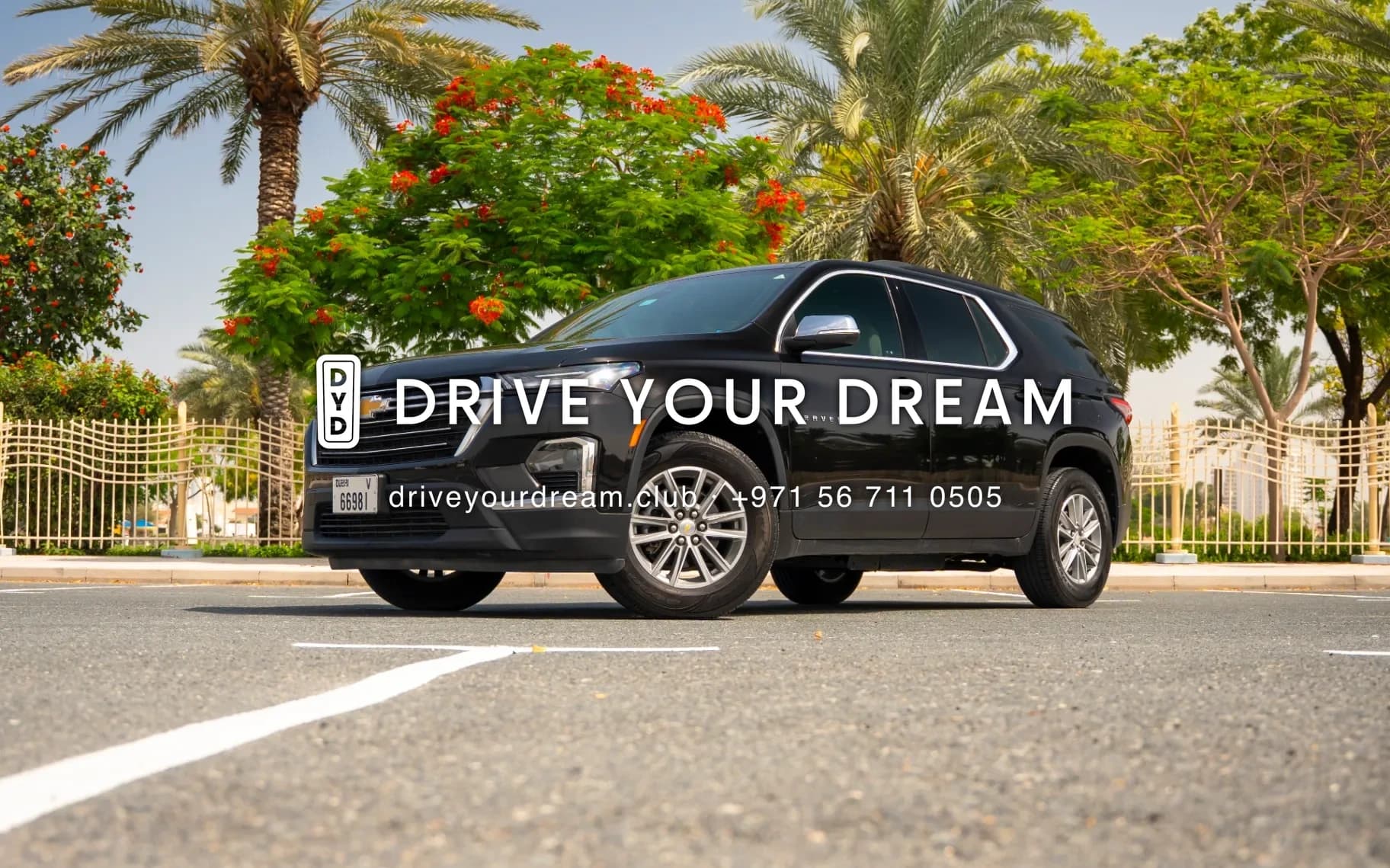
Chevrolet Traverse 2023
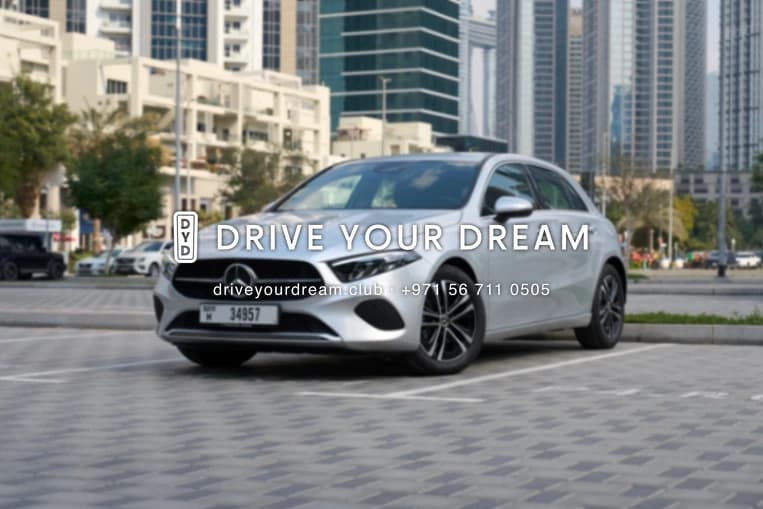
Mercedes-Benz A-Class 2023

Mercedes-Benz A-Class 2023

Mercedes-Benz A-Class 2023
Three mistakes worth naming
Buying for the exception. The seven-seater bought for two annual airport runs, driven with one passenger the rest of the year. Rent a bigger car for those two weekends; it is dramatically cheaper.
Downgrading the class to save money. As the arithmetic above shows, three of the four cost lines do not care what you drive. Dropping a segment moves the payment and barely touches the other AED 1,090. If you genuinely need to cut, cut the vehicle value — not the usefulness of the car.
Choosing on fuel economy. At 1,500 km a month the gap between a thrifty crossover and a large V8 is about AED 200. It is a real number and it is not the number that should decide anything. People routinely accept a worse car every day to save less than they spend on coffee.
How to actually decide, in order
If you want the whole thing as a sequence:
One. Write down your ordinary week — kilometres, passengers, parking, cargo, highway share. Ordinary, not exceptional.
Two. Set the total budget at 20% of net income, and build it from all three lines rather than the payment alone.
Three. Eliminate on hard constraints. Seats needed. Parking that actually exists at both ends. Anything that fails these is out, however much you like it.
Four. Among what survives, choose on the thing you have not yet allowed yourself to weigh — which one you want. By this point the practical work is done, so preference is a legitimate tiebreaker rather than a risk.
Most people do these in reverse and then reverse-engineer justifications. That is how you end up with a car that is technically correct and quietly wrong, which is the most expensive outcome of all, because you will replace it early.
Frequently Asked Questions
How do I choose the right car in Dubai?
Start from your ordinary week rather than a car class: kilometres driven, passengers on a typical day, parking at both ends, cargo, and the highway-versus-congestion split. Set a total budget at 20% of net income counting the payment, the annualised renewal fee and around AED 1,090 of running costs. Eliminate on hard constraints, then choose on preference among what survives.
Should I get an SUV or a sedan in the UAE?
If you commute alone most days and park in buildings, a sedan rides better at highway speed and parks in the spaces that actually exist — and in our fleet a BMW 520 at AED 1,454 or an Audi A6 at AED 1,600 undercuts many crossovers. If children travel with you daily, the elevated hip point and boot geometry of an SUV are worth real money in daily convenience.
Is a seven-seater worth it for a family of four?
Often yes, but not for the seats. Folded flat the third row gives you an unusually large boot, which is a weekly benefit rather than an occasional one, and the seats are there for the airport run or visiting family. In the fleet that starts at a Chevrolet Traverse at AED 2,327 a month — the more expensive seven-seaters solve a different problem.
What percentage of income should go on a car in Dubai?
Under 20% of net monthly income, counting the total rather than the payment. That means the monthly for the vehicle, plus the annual renewal fee (5% of vehicle value, minimum AED 8,000) divided by twelve, plus roughly AED 1,090 of fuel, Salik and parking. On a AED 3,500 car the honest total is nearer AED 5,590.
Does choosing a smaller car actually save much in Dubai?
Less than expected. Salik, parking and fines are identical whatever you drive, and fuel differs by only about AED 200 a month between a mid-size crossover and a large V8 at 1,500 km. Downgrading a class moves the payment and barely touches the other roughly AED 1,090, so if you need to cut costs, reduce the vehicle value rather than the usefulness of the car.
Is it reasonable to choose a car for image in Dubai?
Yes, and it is more honest to budget for it explicitly than to disguise it as a practicality argument. If you meet clients or your business depends on first impressions, the car is a working asset. The more common and costlier error is buying the wrong signal — a car that shouts in a room that rewards understatement — rather than spending too much.
Run your own number
The calculator shows both lines — the monthly payment for the vehicle and the annual renewal fee covering insurance, registration and admin.
Work out your budget first